Land Business Update | Week Commencing 3 August 2026
Farming & food
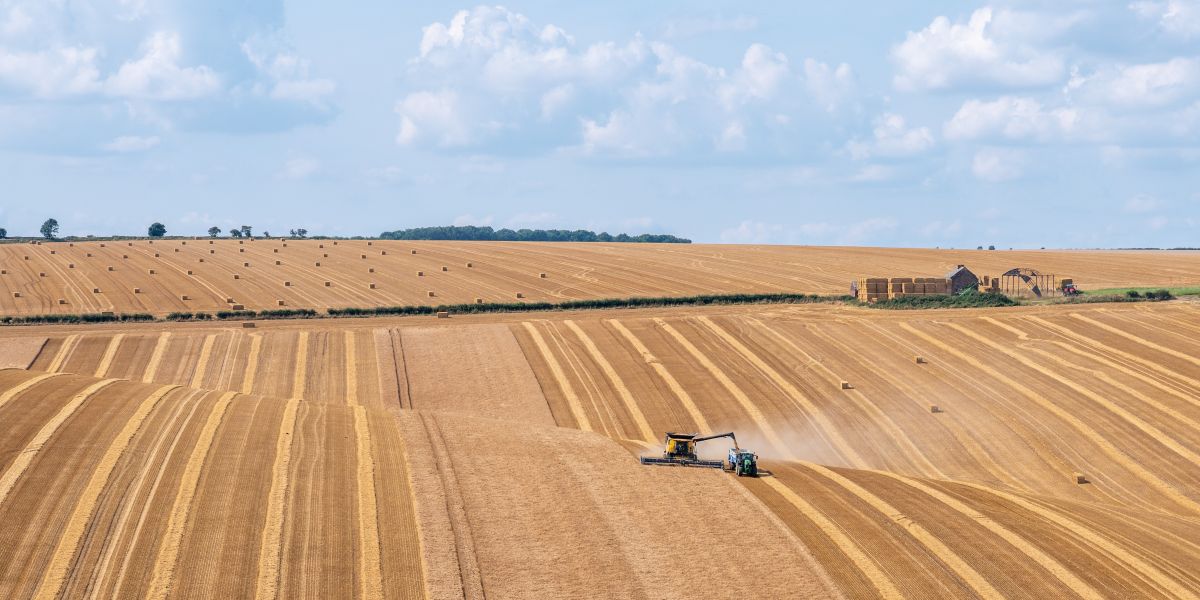
Early reports are of a very mixed harvest (England)
Reports from a variety of sources are suggesting that:
- Wheat – is very mixed, with yields down to 6-7t/ha for farms which produce 10-11t/ha in more typical years. The yield penalty appears to be greater on lighter soils.
- Oilseed rape – reasonable to good, with yields of 3-5t/ha.
- Barley – winter barley has fared a lot better than spring sown, which is highly variable depending on whether it was sown early and had some rain or late.
- Vegetables – Barfoots report that tender stem broccoli yields fell by 50% in 2025 at the peak of heatwave. However this year, with greater access to irrigation, yields are down 25-30%, so the reduction has been halved.
Countryside Stewardship Higher Tier (England)
Expressions of interest can now be submitted for agroforestry and woodland improvement agreements, as well as new single-focus agreements that cover scheduled monument management and species-rich grassland. Please contact your local farming team if you would like any assistance.
Natural capital & environment
Earth Overshoot Day was on July 30 2026 (Global)
This means that humanity, from 1st January 1 to 30th July, has used up as much from nature as the Earth’s ecosystems can regenerate in that year. Put another way, we are currently using nature 73% faster than ecosystems can regenerate, the equivalent of living off 1.73 Earths. This is based on the latest National Footprint and Biocapacity Accounts. So what can you do? There are lots ways to respond to and the Power of Possibility highlights more than 100 options that are already available and financially advantageous in five key areas: Cities, Energy, Food, Population, and Planet. Given this year’s weather, it’s worth getting a cool drink and reading them!
Rural economy & property
Burnham government policy and direction (UK)
There have been further policy announcements that affect rural places and property:
- Stamp Duty, council tax and business rates – the government has confirmed that there are no plans for wholesale changes in this year’s budget, despite the PM being a strong advocate for reform in the past. However, this does not mean that there will not be any change, as ministers have reiterated their commitment to making taxation fairer and have highlighted concerns that outdated property valuations have created disparities between areas.
- Controls on residential rents – the housing secretary has ruled out them out, ending some speculation.
- Removing VAT on household electricity bills – this applies from October and will save a typical household about £45 a year. It may also encourage greater update of heat pumps and electrical heating.
- Protecting high-streets and leisure – there will be 20% business-rates relief for pubs, clubs and live-music venues from April 2027, as well as proposals to abolish rates for cafés and shops.
There is clear continuity in the ministers appointed to a number of departments that are relevant to rural areas:
- Defra – the new secretary of state, Angela Eagle, was recently a minister in the department and seemed to be empathetic and calm. In her team of five ministers and under-secretaries, three previously had roles in the department (Baroness Hayman, Emma Hardy and Stephen Morgan), so we hope there will be continuity in approach and little delay in activity.
- Energy Security and Net Zero – Miatta Fahnbulleh, who is the new secretary of state, is committed to net zero (as is the PM based on past statements). She clearly has the new PM’s ear as a core member of the team that is advising him on his suite of policies. Her supporting team also has DESNZ experience.
- Housing and planning – Matthew Pennycook remains in post on housing and planning, and will now also attend Cabinet, so this subject has been elevated to Cabinet, which is positive, and policy continuity could also be expected here.
- Farming and food strategy – the Starmer government took a number of significant, strategic actions, including producing the Land Use Framework (March 2026), Farming Roadmap (June 2026) and establishing the Farming and Food Partnership Board (March 2026); as stated above, many of the senior team will have been involved in their production and we expect the documents to continue to set direction.
- Environmental Land Management schemes – early briefing from Defra is that the approach of making incremental changes to the ELM schemes will continue, rather than significant reforms to them. This is positive as it helps provide policy certainty.
- Rural impact test – Emma Reynolds, who was the previous environment secretary, was working with a cross-governmental rural task force so that any formal policy documents sent to ministers have a check box asking civil servants if rural communities have been considered during their review. Currently, this only happens within Defra. She was also considering whether to set rural growth targets to ensure the government is helping businesses in the countryside. It is unclear whether these approaches will continue although, with Reynolds’ promotion to the Treasury, we hope she will continue to work to reduce departmental siloes.
We should talk about bringing electricity bills down, not making sacrifices to reduce climate change, says Octopus (UK)
Greg Jackson, the chief executive of Octopus, said that, ‘we could not have gone about the electricity transition in the UK and Europe in a worse way if we wanted to get public opinion to support it’. He said that politicians (and actually everyone) should line up environmental policies with the public’s immediate self-interest, rather than telling people they have to make sacrifices. Octopus has long made the case that greening the UK’s electricity grid and introducing local electricity prices will reduce energy bills.
Separately, a survey of almost 2,000 executives across 18 countries including the UK found that 91% believed the switch from fossil fuel-powered equipment to electric alternatives, such as electric furnaces, heat pumps or vehicles, would improve their energy security.
And separately separately, another survey of 1,600 UK business leaders across 28 sectors found that two-thirds said they have lost more than 1% of their annual turnover as a result of climate impacts in the past 12 months. 40% said that the hit was 6% or more.
Summer tree limb drop – managing the risk during hot weather (UK)
Periods of prolonged hot, dry weather are associated with an increased likelihood of large branches failing unexpectedly from otherwise healthy mature trees. Although relatively uncommon, failures have been reported from a range of broadleaf species including oak, beech and horse chestnut. Where properties welcome members of the public, it is sensible to consider taking additional precautions, such as reviewing the location of seating areas and activities and reminding staff to remain vigilant for obvious signs of deterioration. If you have concerns regarding trees on your property, please contact Gulliver Hedley, our Health and Safety Manager.
Heat pump grant increased to £9,000 for off gas grid properties (England)
The grant, up from £7,500, is available through the Boiler Upgrade Scheme for both domestic and non-domestic premises which are off the gas grid. There is a heat pump checker tool to assess whether a pump would suit your property.
Wildfires (UK)
Our teams in Scotland, and increasingly in England and Wales, are becoming more involved in planning and preparedness for wildfires. This includes having a written plan, clear maps and agreed actions in the event a fire does breakout. More generally, in Scotland there are calls for national resourcing of dedicated helicopters so responses can be faster; a continuing debate about land management practices and fuel burden; and discussions on the importance of training staff to manage fires with the right equipment. If you would like to discuss this, please contact Alice Rawdon-Mogg.