Land Business Update | Week Commencing 15 June 2026
Farming & food
Sustainable Farming Incentive (SFI26) to have £240m funding (England)
The funding will be split £60m for Window 1, which opens on 30 June for farmers without an ELM agreement and farms under 50 ha, and £180m for Window 2, when opens in September for all other farmers. Defra has also confirmed that its IT systems are being modified to allow those with agreements that are ending soon to apply before they end, to avoid a gap in their payments. This is likely to include expiring agreements under SFI23, Countryside Stewardship Mid Tier (CSMT), Legacy CS Higher Tier (CSHT), and Environmental Stewardship Higher Level Stewardship (HLS). This is good news and is expected to be available from the start of Window 2 in September. Therefore some small farms with expiring agreements may want to wait and apply during Window 2. An additional £50m is available for new Countryside Stewardship Higher Tier (CSHT) agreements this year. Demand is expected to be high and lots of applications are likely to be submitted as soon as the windows open, so please contact your local S&P office to discuss preparing an application well in advance.
Capital Grants 2026 – details published so prepare now in advance of July opening (England)
The guidance document for this year’s grants is now available. The structure of the grants is largely unchanged, with the same categories of grants available (boundaries, trees and orchards, improved water quality, improved air quality, improved natural flood management, assessments and improvements) and the same funding limits per group (£25 or 35k, dependent on the group). The main change is that agroforestry items will not be available through this grant but have been moved to the Higher Tier Capital Grants offer, which is available later this year. This is a popular grant, with almost 8,500 applications made for the 2025 edition, all of which were funded. Its funding has been increased significantly for 2026 (to £225m) and we expect it all to be spent, particularly given many farmers are considering changes to their farming systems due to profitability and climate change challenges. Therefore, as for SFI26, we recommend preparing in advance and submitting an application early. Defra is going to say when a quarter, half and three quarters of the funding has been requested but we strongly advise against waiting as it may be spent up at short notice. Please contact Natalie Gaibani, our head of farming, if you would like to discuss the grant.
UK vineyard business survey 2026 – last call for responses (UK)
Our survey, which takes five minutes to complete, aims to produce a picture of the state of the UK vineyard sector by asking viticulture businesses about the factors that impacted the performance of their businesses in 2025. The survey is here and any responses will be treated as confidential.
Apply for a Local Resource Option (LRO) screening study (England)
This grant pays for groups of farmers to get a screening study produced by a specialist water resources consultant. The studies can assess the water resources in the area and provide advice on the options that may work best, such as farm storage reservoirs (new, resizing and/or change to multi-season operation), water rights trading, water efficiency tools, treated effluent/wastewater reuse and rainwater harvesting. Applications should be submitted by 5th July. This is this third round of this type of screening and the Environment Agency says that feedback from the land managers that took part is that it was useful.
FarmersAid app launched (UK)
Farming remains a dangerous industry and the first minutes after an accident are often very important. This free app for mobile phones guides people through step-by-step instructions to follow before emergency services arrive. It works offline and has been designed to be simple to use.
Natural capital & environment
Increase in solar panel installations in 2025 (England, Wales, Scotland)
Nearly 270,000 installations were completed, up 37% on 2024’s levels, and the equivalent of a rooftop panel being installed every two minutes. There are now over 2m installations across Great Britain. Solar Energy UK, a trade body, says that demand for solar is at record levels as households and businesses are responding to rising energy costs by taking more control of their own power bills. Ofgem has announced that the domestic energy price cap will increase by 13% from July, driven by the ongoing US / Israel – Iran war and rising gas prices. Electricity bills are set to rise 5%, while gas bills will grow 24%.
Show your stripes day – 20th June (UK, global)
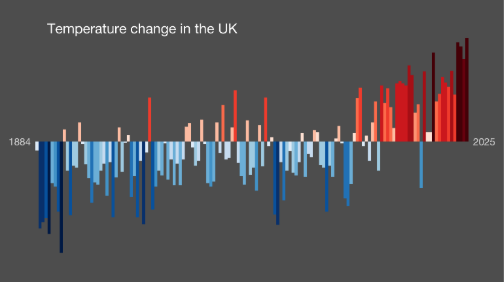
A meteorology professor at the University of Reading, Ed Hawkins, created one of the most powerful representations of how temperatures have increased around the world since the Industrial Revolution – the climate stripes. Each stripe represents one year’s average temperature relative to the average temperature of the time period between 1961-2010. The colours transition from cool blues to warm reds to represent the increases in temperature seen throughout the past 150 years or more. 2024 was the warmest year on record globally. Extreme weather events continue to be seen more frequently around the world. Never has the need to address climate change been more urgent. Visit the climate stripes website and, more importantly, consider what you can do personally and professionally to help protect our environment. There’s a good page of practical ideas on the website.
New nature impact fund launched (England)
Finance Earth has launched the Big Nature Impact LP, a nature fund that will invest in woodland creation, peatland restoration and other habitat creation projects across England. The fund’s aim is to mainly generate revenue from the sale of high-quality carbon credits and biodiversity units from the projects it invests in. It has raised £65m so far, including a £30m investment from Defra, making it the largest nature restoration fund in the UK to date. The fund aims to raise £90-120m.
Oak Processionary Moth (England)
The moth’s caterpillars emerge in May / June, so the risk of irritation from their hairs is greatest now. It is established in most of Greater London and in some surrounding counties. The caterpillars eat oak leaves and large numbers of them can strip whole trees bare, leaving them vulnerable to other threats. All land managers should keep an eye open for them and be especially vigilant in places with public access. The Forestry Commission website has some good identification photos. Within the OPM management zones there are movement restrictions on oak trees with a girth of 8cm or more (or 2.5cm diameter). NB There is separate guidance for Scotland and Wales.
Take part in a research project on the resilience of hawthorn in hedges (UK)
Hawthorn is the main plant in hedgerows throughout the UK, which play a crucial role in supporting biodiversity, storing carbon, preventing soil erosion and connecting habitats. Despite this, little is known about how resilient hawthorn populations are to emerging threats. This project is focusing on two key disease concerns: fireblight and gymnosporangium rusts. Forest Research is asking anyone to look out for hawthorn trees in their local area, from May to September, and to take photographs and, where symptoms are suspected, carefully collect and post samples following a provided protocol. More details are here.
Rural economy & property
Scottish Land Commission’s 2026 rural land market report (Scotland)
This is the fifth report in the annual series on the farmland and estates, forestry and natural capital markets. We are delighted, again, that our market reports are widely quoted in the report, which also noted that Strutt & Parker was the only agent to produce a farmland report specific to Scotland. If you would like to discuss the markets, or the SLC’s report, please contact Rob McCulloch, our head of Estates and Farms Agency in Scotland or Simon Hart, our Head of Forestry.