In the Know: Agroforestry grants and funding
Agroforestry is gaining momentum across the UK as farmers and landowners look for resilient, profitable systems that work with natural processes rather than against them.
Agroforestry essentially integrates trees with crops or livestock to create a more diverse, productive and climate-resilient farmed landscape.
This approach is not new, as trees have been a part of the farmed landscape for thousands of years. However, environmental and market pressures, new market opportunities and a range of Government incentives are all driving new interest in this approach.
What is agroforestry?
Agroforestry combines trees with farming in ways that enhance, rather than hinder, agricultural output. Two of the most common systems in the UK are:
- Silvopasture – Integrating trees with grazing livestock.
- Silvoarable – Integrating rows of trees within arable cropping.
What are the potential benefits for farm businesses?
Agroforestry requires significant upfront investment and is a long-term venture, but has the potential to offer a wide range of environmental and economic benefits, many of which are highlighted in recent industry research and the Agroforestry Handbook (The Agroforestry Handbook, Second Edition – 5m Books).
These benefits include:
- Improved livestock welfare – Shade and shelter reduce heat stress and can also reduce instances of liver fluke and mastitis, improve weight gain and support better grass utilisation. Silvopasture systems can also create more stable microclimates, reducing wind exposure and improving animal wellbeing.
- Flood mitigation and water management – Tree roots increase soil stability and reduce runoff through their water uptake and root system, which helps to slow the flow of water during heavy rainfall events. This is particularly valuable in catchments where soil erosion and nutrient loss are prevalent.
- Soil health – Trees contribute organic matter to the soil through leaf and branch drop as well as through their symbiotic relationship with mycorrhizal fungi, improving soil quality, which results in a healthier, more stable nutrient rich soil. Better water infiltration can also reduce compaction.
- Increased biodiversity – Trees support beneficial insects and mammals by providing food, shelter and habitat which creates structural diversity across the holding. This can lead to a healthier ecosystem, better and increased pollination and natural pest control.
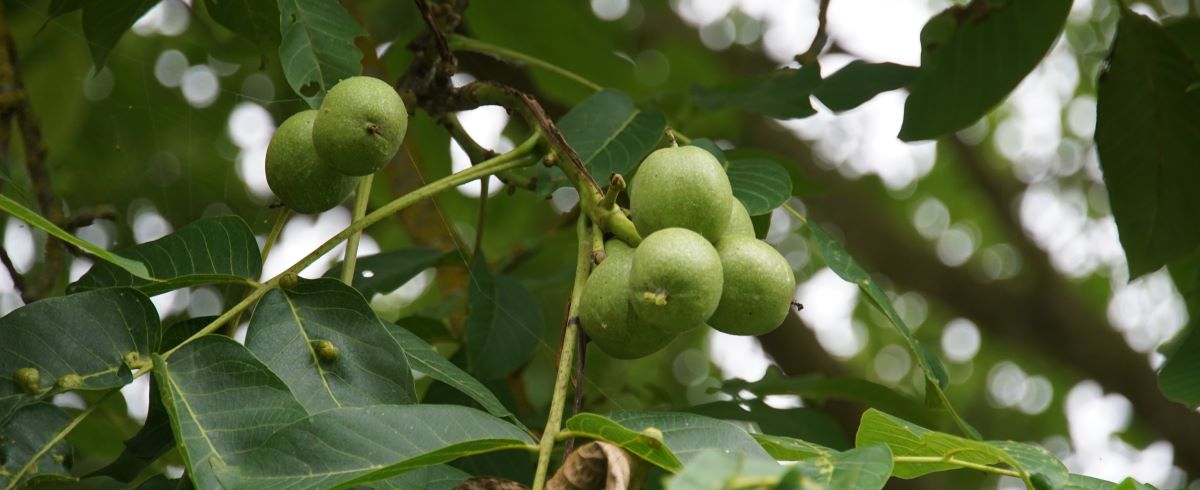
- Diversified income streams – Where two crops are being grown on the same land, there should be an increase in overall productivity per hectare given the trees can also provide timber, fruit, nuts or wood fuel. Some landowners are exploring new market opportunities, withhigh-value tree crops such as hazelnuts and walnuts gaining more attention.
Is nut production in the UK commercially viable?
Nuts can be grown successfully at a commercial scale in England, but they represent a long-term investment. Establishment costs are relatively high, as young trees typically require deer fencing for protection. Some trees, such as walnuts, can take up to 30 years to reach peak production, resulting in a lengthy payback period for landowners, albeit a reasonable crop may be expected after 5-7 years depending on the variety
Once established, however, nut orchards can generate attractive returns for many decades, with comparatively low ongoing maintenance costs. Key risks include disease and market considerations, particularly the management and marketing of nuts that do not meet the size or quality specifications of the primary end market.
What payments and incentives are available?
England
In recent years the Government in England has introduced financial support for agroforestry planting through its Environmental Land Management (ELM) schemes. Payments are available for planning, the purchase of trees and associated items, and the management of the project.
The grants include:
Planning – PA4 – Agroforestry Plan
A payment of £1,268.08 per plan is available to plan the creation, improvement or management of an agroforestry project, either as a standalone agreement to aid a Countryside Stewardship Higher Tier agreement, or, if on less sensitive land, a Sustainable Farming Incentive application. More information on this payment and eligibility can be found at PA4 Agroforestry Plans.
Planting – Capital Grants
The Government’s Capital Grant scheme is set to open in July 2026. However, this year, the agroforestry items and the woodland condition assessment will not be available through the standalone Capital Grant scheme. They will instead be available later this year through the Higher Tier Capital Grants offer. Further details are yet to be announced. Before planting, sites must be checked for sensitivity via the Forestry Commission’s sensitivity map available at Land with Low Sensitivity to Agroforestry | Forestry Commission Open Data website.
Items available later in the year for agroforestry projects include:
| Item | Payment Rate |
| AF1: Plant an agroforestry woodland tree | £5.40 per tree |
| AF2: Plant an agroforestry fruit tree | £17.83 per tree |
| AF3: Species diversity bonus supplement (where 5 or more different species of tree are established so they each make up at least 10% of the planting) | £1.16 per tree |
| TE7: Tree guard (large post and rail) | £121.62 per guard |
| TE8: Tree guard (small post and rail and wide weld mesh) | £74.74 per guard |
| TE19: Tree guard (narrow weld mesh) | £35.67 per guard |
| FG1: Fencing | £6.34 per metre |
| FG2: Sheep netting | £7.47 per metre |
| FG3: Permanent electric fencing | £5.66 per metre |
| FG9: Deer fencing | £10.27 per metre |
Management – Agroforestry Management Payments
Sustainable Farming Incentive (SFI)
It has been announced there will be two actions available within the SFI 2026 scheme for the maintenance of planted agroforestry sites.
These actions include:
| Action | Payment Rate | Notes |
| AGF1 – Maintain ‘very low density’ in-field agroforestry on less sensitive land | £248 per ha per year | 30 to 50 trees per hectare |
| AGF2 – Maintain ‘low density’ in-field agroforestry on less sensitive land | £385 per ha per year | 51 to 130 trees per hectare |
Countryside Stewardship Higher Tier
Agroforestry taking place on more sensitive land, would fall into Countryside Stewardship Higher Tier (CSHT).
Actions include:
| Action | Payment Rate | Notes |
| CAGF4 – Very low density in-field agroforestry on more sensitive land | £248 per ha per year | 30 to 50 trees per hectare (ha) |
| CAGF2 – Low density in-field agroforestry on more sensitive land | £385 per ha per year | 51 to 130 trees per hectare (ha) |
| CAGF3 – Medium density in-field agroforestry | £595 per ha per year | 131 to 250 trees per hectare (ha) |
| CAGF1 – High density in-field agroforestry | £849 per ha per year | 251 to 400 trees per hectare (ha) |
To apply for any of the CSHT agroforestry options, a PA4 – Agroforestry plan must be completed.
Regional funding support
Depending on location, tree planting grants (including ones for agroforestry) may be available through one of Defra’s Woodland Creation Partners, with some eligible schemes starting at as little as 0.1 ha.
Read more at local Woodland Creation Partners.
Scotland
Forestry Grant Scheme – Agroforestry
This option provides grant support to help create agroforestry systems within grazing pastureland (silvopastoral system) or on arable land (silvoarable system).
This woodland creation option supports investment in three main areas:
- Aim 1 – Broadleaves suitable for timber production.
- Aim 2 – Broadleaves for biodiversity.
- Aim 3 – Fruit/nut trees for business diversification.
Grant support
This grant has two payment types:
- a capital grant for initial establishment
- an annual maintenance grant that is paid for five years
The rate of capital grant you can claim depends on the number of trees that you plant per hectare. Two stocking levels and grant rates are available:
| Planting density | Initial payment | Annual maintenance |
| 300-400 trees/hectare | £5,400/ha | £126/ha/year |
| 150-200 trees/hectare | £2,790/ha | £72/ha/year |
The rate per hectare has been set to cover:
- purchase of trees
- purchase or construction of appropriate protection
- planning, site assessment, supervision, ground preparation, and planting
- contribution to the cost of beating up and weeding
The minimum stocking densities expected by establishment (year 5) are 300 per hectare for the higher payment rate and 150 per hectare for the lower payment rate. These minimum densities must be maintained as such until the end of the contract period.
Wales
There two agroforestry options offered under the Woodland Creation Grant. Grants are available for the planting of scattered trees in either an upland or lowland setting, with an additional maintenance payment for 12 years. The minimum plot size is 0.5ha.
| Action | Initial payment | Annual maintenance | Notes |
| P006 – Upland Agroforestry – Scattered Trees | £2,800/ha | £74/ha/year | 80 trees per hectare (ha) |
| P007 – Lowland Agroforestry – Scattered Trees | £2,240/ha | £74/ha/year | 50 trees per hectare (ha) |
This article forms part of our ‘In the Know’ series which sees Strutt & Parker experts share insight and advice on how farms and estates can improve their business and environmental resilience. To discuss agroforestry grants, please contact Lauren Clarke or Elizabeth Smith (England) or Sasha Laing (Scotland).